Introduction
by Uri Appenzeller
On a train from Chicago to New York during the winter of 1926 sat a forty-six-year-old man, weary from a failed speaking tour across America. He was a Russian Jewish refugee holding a Nansen passport – the passport for the stateless – a veteran of the Great War, scholar, journalist, poet, and a liberal-democratic political leader in the Jewish national movement in Europe and Mandatory Palestine. He was burned out, broke, and burdened by an impossible mission: organizing his brothers and sisters for their freedom from antisemitism and political oppression in Europe. What he hoped to find in America was a sign of hope, a hint of redemption and renewal that would ease the plight of his people. Ever since he was a child in Odessa, Ze’ev Jabotinsky had turned his ears to America, the great teacher of what most European Jews could only dream about: liberty and the pursuit of happiness. From the poetry and literature of Poe, Cooper, and Twain to the cinema of Griffith and Chaplin, America had shown him the meaning of the spirit of mass pioneering, social deliverance, and a brighter future for humanity.
On the train platform, surrounded by activists and Jewish crowds, Jabotinsky found himself bored. His supporters, he complained, were “hiding the view.”1 Fortunately, he was traveling with Mae Frohman, a young secretary who worked for Sol Hurok, aspiring impresario.2 Mae was different. Touring the country with Hurok’s musicians and talent, she knew where to find America’s living pulse. That night, she promised to take Jabotinsky to a local speakeasy in Harlem where jazz was played. What happened next changed the course of his story and linked his name to jazz’s global influence.
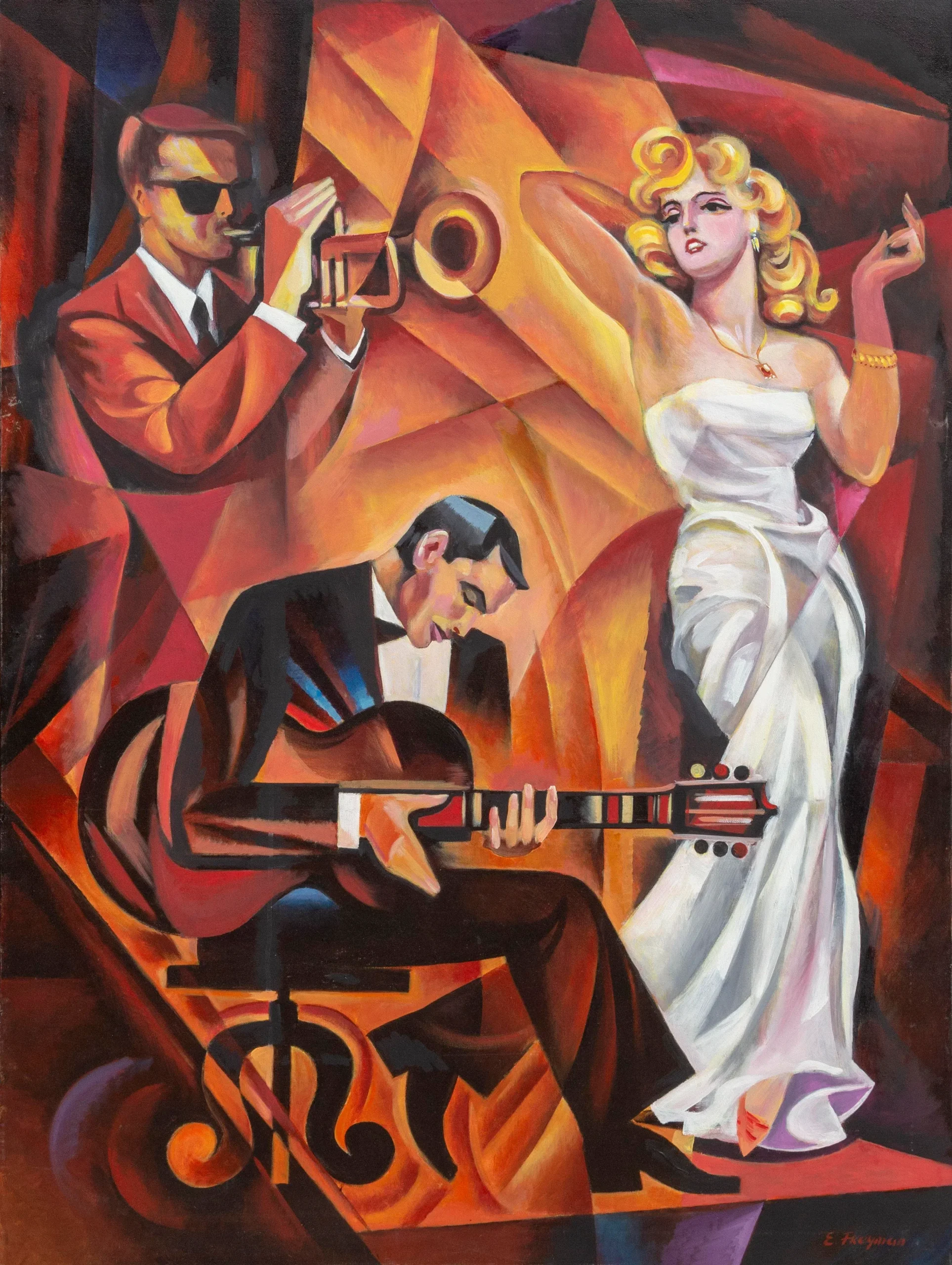
Walking down the dark, smoky stairway to the club, Jabotinsky was gripped by an unfamiliar rhythm: a hard-driving swing band, unlike anything he had heard in Europe. Yet something in the beat still felt familiar, like the thousands of trains that had carried him across continents. It was modernity’s promise set to music – an art form whose robust sound of freedom challenged artistic and social conventions.
Walking down the dark, smoky stairway to the club, Jabotinsky was gripped by an unfamiliar rhythm: a hard-driving swing band, unlike anything he had heard in Europe. Yet something in the beat still felt familiar, like the thousands of trains that had carried him across continents. It was modernity’s promise set to music – an art form whose robust sound of freedom challenged artistic and social conventions.
From an early age, Jabotinsky studied and wrote about music, developing what musicians call “big ears”: an ability to perceive hidden structures and deep emotional resonances within music.3 In Harlem, he heard notes, tones, noises, knocks, howls, and a racket – exceptionally inclusive, interesting, and engaging. Where many heard only dance music, however, Jabotinsky’s big ears detected in the rhythm a translation of the machine age. He also absorbed the all-encompassing, penetrating energy of the men and women on the dance floor. This was no ordinary dance: the music entered their bodies, minds, and souls, provoking them to stomp, clap, and turn like steam-engine machinery, facing their troubles, fears, and doubts, and then crushing them under its blissful rhythmic path. What’s more, the musical innovations were matched by a simplification of the relations between the men and women in the dance hall.
Jabotinsky heard in the music the heartbeat of liberty, and it freed him from despair. Here, in the jazz club, Jabotinsky finally found what he was looking for in America: a modern spiritual revelation and awakening. He recognized how Black American music taught the world the meaning of freedom, despite all the pain and hardship, and revolutionized the way we think, act, and react to art and reality.
Jabotinsky heard in the music the heartbeat of liberty, and it freed him from despair. Here, in the jazz club, Jabotinsky finally found what he was looking for in America: a modern spiritual revelation and awakening. He recognized how Black American music taught the world the meaning of freedom, despite all the pain and hardship, and revolutionized the way we think, act, and react to art and reality.
Soon after his time in Harlem, Jabotinsky reported on his musical experience in a local Yiddish daily, describing “a new kind of music that would also receive and record the noise of the modern movement and the inferno of thousands of machines in the factories, and even the sound of an airplane’s snore. America did not plead; it acted and triumphed through Jazz.”4 Jabotinsky documented what decades later the jazz scholar Albert Murray would call “locomotive onomatopoeia”: the train groove embedded in the music’s rhythm and inspired by the “old steam-driven locomotive as a fundamental element of immediate significance in the experience and hence the imagination of the so-called black southerners.”5 Other jazz historians, such as Martin Williams and Joel Dinerstein, also described jazz’s recalibration of the relationship among rhythm, melody, and harmony, and rhythm’s capacity to humanize the machine age. In Dinerstein’s account, the machine aesthetics inside big band swing – speed, repetition, and power – helped explain its enormous popularity. For Jabotinsky, the meaning of jazz’s rhythm was emancipatory, even as he sensed the envy, unrest, and upheaval it might unleash.6
He did not lose sight of this incendiary subject, publishing a revised version of the original piece in Russian in 1928, translated it into French soon after, and then penned an English version, “America Has a Rhythm,” in Paris in 1932.7 That English-language essay appears below in print for the first time. In the essay, Jabotinsky transforms his Harlem revelation into a fictional conversation between two Europeans and a friend just returned from America, through whom he explores how this new rhythm has already broken down so many of Europe’s old fences. The conversation moves in widening circles: from American boys’ books and mass pioneering, to Poe, Baudelaire, and fin‑de‑siècle “decadence,” then on to cinema, envy, and finally to jazz and dancing, where Jabotinsky tests how far America’s mass pioneering can go in dissolving the fences of class, taste, and sexuality.
Ultimately, jazz provided Jabotinsky with a sense of political optimism that nothing can prevent humanity from liberating itself from social, cultural, and political chains. In “America Has a Rhythm,” he leaves that process provocatively open – “for better for worse” – as the same rhythm that dissolves aesthetic hierarchies and sexual conventions unsettles inherited norms. Yet his own response to Harlem suggests that he heard, within this risky, embodied freedom, a rhythm capable of carrying his boldest dreams, including freedom and independence for the Jewish people. For it is no dream if we accept reality as it is, even at its cruelest, and believe that our most sacred and revolutionary aspirations are valid, realistic, and permissible to the mind, just as jazz is to the ear and heart.
Uri Appenzeller is an Israeli historian and postdoctoral fellow at the Azrieli Center for Israel Studies at Ben-Gurion University studying Jewish political conservatism. An honors graduate of both NYU and the University of Haifa, he is also the author of the historical novel Brit Ha-Biryonim, which explores the rivalry and friendship between Zeev Jabotinsky and David Ben-Gurion.
America Has a Rhythm
by Ze’ev Jabotinsky8
A few days ago, two friends came to see me, one of them had just returned from America, the other had never been there. It was the latter who remarked: “I’d like to go to the United States and see what people live there by.”
“It isn’t worth it,” the other answered. “America is right here. It surrounds you, you breathe it in, and not only now but ever since childhood.”
I interrupted and said, “Are you referring to Cook’s Tourists?”9 – “No,” he answered. “Not to them but to the real essence of America, to ‘what people live there by’, as our friend said. This quintessence of America literally fills every cranny here in Europe. It is very curious that you haven’t noticed yet. Of all the spiritual influences that have changed European life in our generation, the strongest is the American.”
“How paradoxical!” cried my other visitor. “I belong to the same generation as you, and grew up, as you did in pre-war Russia. Who influenced us? At one time the French decadents, then German Social-Democrats, and later Norwegian novels. But America – never. And now here, in Western Europe, and I believe in all parts of Europe, the chief matter for all our spiritual searchings and wrangles is by no means America but Soviet-Russia.”
“You are mistaken. Let’s begin with our childhood. There were hardly any original Russian children-books then – Kot-Murlyka’s and Zhelihovskaya’s tales and that’s all10. But we read perpetually. Nine out of ten books that we borrowed from the library were translations. And eight out of these nine were American – Main Reid, Cooper, Bret Hart, and all the plots of Gustave Aymard, and a good half of Jules Verne’s.
“You can’t quote such trifles,” the man who had not been to America said. “Even before reading Aymard, we read fairy-tales – do you then think that because of this we became spiritual citizens of the once-upon-a-time country?”
“You can hardly compare the two things,” I said, but purely from motives of hospitality and politeness, as I myself also thought that the American was exaggerating. “Fairy tales are mere fables, and even children know this, but the adventures of the Pathfinder and of Gabriel Conroy have, after all, some sort of claim to probability, and it is undeniable that such readings developed in us a taste for, at least, strong emotions.11
“That’s right,” said the American. “Only I want to correct something. Not just any strong emotion, but only of one sort. The American adventures that we read about always dealt with pioneering. They were nearly always the adventures of people who left well-appointed settlements behind them for open spaces where, at the time, there was neither law nor plough. So, mark, first of all, the kind of yarn we used to feed upon in those years was nearly always about pioneers. And secondly, remember the heroes. The hero was very seldom a gentleman with the imprint of genius on his brow, what is now known as the born leader. Mostly, he was an ordinary tramp, of mediocre brain, shy and clumsy in company. In fact, the ordinary man in the street who for some reason or other hadn’t kept to this side of the fence between civilization and the Great Unmapped. In other words, one of the thousands of ‘unknown soldiers’ who had really extended America from the narrow strip on the Atlantic coast first to the prairies, then to the Rockies and finally to the Pacific Ocean. That is the “secondly” that I want you to remember. First it was the trouble to rise on tip-toe and look out beyond the garden fence; and secondly, not just a pioneer but a democratic, a mass pioneer. Remember this because this is all America. The whole essence of its peculiar spirit lies in this crowd pioneering.”
Remember this because this is all America. The whole essence of its peculiar spirit lies in this crowd pioneering.
“My dear man,” said my second guest waving him away, “even if this is true, don’t forget that we dropped all this picturesque bunk at the age of fourteen and gave our hearts to Baudelaire, Verlaine and their Russian pupils.”12
“Of course. And I will add – we approached Baudelaire as the proper and logical successor of Mayne Reid. Only in another field. In the one case we had been taught to peep over the fence of well-appointed communities, in the other, we got fond of writers who showed us what was happening on the other side of the fence round well-appointed souls. What was this ‘decadence’? It was a break with commonplace, orthodox psychology, a journey among strange and unexplored spiritual experiences. Once again, Pioneers. And most important: once again pioneers of American extraction. Who was it who first tried to capture the Demon of the Grotesque? Who was it who first lifted the curtains round the usual ‘healthy’ soul and looked into the witches’ cavern, which is probably hidden in every human brain – only we did not know about it before? Baudelaire practically began his literary ascension by translating the American Edgar Allen Poe. And this is what it means: Poe died in 1849, died – according to a malevolent and discredited legend – ‘in a ditch under a fence’ on the high road between Richmond and Baltimore; but if you will excuse this excursion into symbolism, I accept the ‘fence’ myth. Only before dying he had bored in that fence a peephole into the darkness which lies beyond consciousness. And although America has particularly forgotten him, Europe sent to this ‘fence’ scores of her most curious, most active minds, and they all clung to the peephole opened by this citizen of the State of Virginia. And this was the source of one of the most powerful spiritual movements of modern civilization.”
My other guest got quite angry:
“Symbolism and decadence as one of the most powerful movements? That means exaggerating it to an absurd extent. It was just a literary fashion without any tangible effect upon realists. It came and went.”
“Sir, you have a bad memory. You forgot the term ‘fin de siècle’ and that vast all-embracing iridescence of moods and passions it used to convey. There was a decade during which that term lived on the lips of every educated person, and Nordau’s book of ‘Degeneration’, chiefly written against the phenomena of ‘fin de siècle’ cult, came near to dividing the world’s thinking antheap into two camps. Even if only a ‘literary fashion’, then it was a fashion of rare potency, as exciting and incendiary as the Romanticism of the generation before. And besides, it is quite incorrect to think that there are literary fashions which leave ‘no tangible effect upon reality’. Of course, reality is a queer mirror and it reflects literature queerly. The romantic school, too, was not reflected in the sense that the people began a cult of hobgoblins a la ‘Lenore’, or took to drinking human blood out of flasks ala Bugue-Jargal.13 But that disgust as well-appointed commonplace, which engendered both essence and the rubbish of Romanticism, found its tangible reflections in the Spanish pronunciamientos, in the revolutions of 1830 and especially of 1848, in Chartism and the Garibaldi epic. That ‘fin de siècle’ found an even more vivid reflection in life will, I am sure, be recognized by future historians. That call to a revision of our entire spiritual luggage, to a destruction of the barrier between the normal and the abnormal, to a leap from the top of the cliff – it only began as a harmless exercise in pure psychology: it soon attracted the realm of ethics and finished where all great ‘literary fashions’ finish – on the barricades. Who in our young days was the teacher and prophet of all those incendiaries by whose fault (or merit) fences are burning today all over the world? His name was Nietzsche, and he was the most typical figure of the ‘fin de siècle’. Nordau placed him among the decadents, and that was one of the few really just verdicts in his book.14 Nietzsche is Edgar Allen Poe’s blood-brother. He applied Poe’s system to another sphere, stepping over barriers not in the field of perception and emotion, but in that of morality, duty, good and evil. So, the origin of all these impulses – I am not saying now whether they be good or bad – is to be found under that fence on the road between Baltimore and Richmond. It’s America, always America.”
Nietzsche is Edgar Allen Poe’s blood-brother. He applied Poe’s system to another sphere, stepping over barriers not in the field of perception and emotion, but in that of morality, duty, good and evil. So, the origin of all these impulses – I am not saying now whether they be good or bad – is to be found under that fence on the road between Baltimore and Richmond. It’s America, always America.
“Very possible,” I said. “But all this is past and long forgotten. Even children, I believe, don’t read those books anymore; older people haven’t any time to read anything. Nobody remembers your ‘Decadents’, including Poe and Nietzsche. The vanguard of modern humanity spend their time in cinemas and dance-halls.
“Quite right,” he cried. “I agree – the chief ‘spiritual influence’ of our time is dancing and the cinema. Here again I am not going to delve into their use or harm. What’s important to determine are two things: first – that both theses influences are extremely powerful, numerically probably more potent than all their predecessors; secondly, it is the American film that dominates the screen, and the dances and the music of American Negroes reign in the dance-hall.”
Such a fall from highbrow stuff down to jazz so shocked my other guest that he even yawned. He said jeeringly:
“Any American patriot would take offense if you mentioned in his presence these two achievements as American spiritual ambassadors to Europe.”
“A short-sighted chap can take offence at anything,” the first replied. “But I can tell you that the American film, the music of the kitchen saucepan and the nigger’s15 dance do obviously and directly carry on the spiritual tradition of la Longue Carabine, of the flight in a cannon ball to the moon, and of ‘The Fall of the House of Asher’.”16
“The screen possibly,” I said conciliatingly, once again trying to exercise my duty as a good host, “Wild West films and all that are certainly Maybe Reid all over again.”
“That isn’t at all what I had in mind,” the American replied, “although this, too, by no means is unimportant: when we were boys we only read about adventure, these children see it; not to mention the fact that readers were counted in thousands and cinema-goers are millions. For this reason alone you are wrong when you say that Fenimore Cooper is dead: under another name he now holds a greater sway over children’s hearts than he had ever before. But it isn’t this category of films that I had in view, mainly much more important and even more popular with the crowd – are the revolutionary films, and it is only in America that they know how to make them.”
At this both, my other friend and I gaped: “revolutionary” films from America? when? where?
“You,” said the American, “don’t properly understand the meaning of ‘revolutionary’. Revolutionary stuff isn’t the kind of stuff that talks directly of revolt. Films showing up poverty and tyranny and so on are not revolutionary, they are nearly unmitigatedly boring and the crowd does not care for them. What the crowd does love are scenes of luxury – palaces, fine cloths, private parks, royalty among curtseying beauties. This is what in America they do so extraordinarily well! Never before had the poor been shown so tangibly, so appetizingly, or in such detail, what Wealth really feels like – and what they themselves are missing! In pre-war cinema days, not only working-man but middle-class people like you and I had no idea how dukes and millionaires really lived; real luxury to us, was but a vague hearsay. Just now they have let us into their festive halls and into their harems… The effect, even to such as you and I, is a tremendous stimulus to envy: but think of those in the cheap seats, think of the masses drinking-in the crushing, the not just imagined but palpable presence of class differences. In the fence between the duke and the beggar a peep-hole has been bored – and what a peep-hole!”
“You,” said the American, “don’t properly understand the meaning of ‘revolutionary’. Revolutionary stuff isn’t the kind of stuff that talks directly of revolt.
“Envy is not revolution, you know,” said my other guest shrugging his shoulder.
“You are mistaken. Envy is the chief factor of revolution; possibly the only one. Moreover, envy is the most important of all motor-wheels of progress. Where all are rotting in the same drudgery, all without any exception that could be envied, why should anyone strive for betterment? If some primitive troglodyte had not stumbled on a more comfortable cave with a nice soft sandy floor, while his comrades had to sleep on granite, there wouldn’t be any central heating today.”
“Splendid,” I said. “Now you have made me curious to learn how you fit even jazz into this scheme of sublimated nonsense.”
“I am not musical, I don’t know much about music,” he replied, “but since you ask me – here you are. A hundred years ago the theory of music began with the distinction between ‘musical’ and ‘unmusical’ noises. The first category was extremely aristocratic, select and exclusive, not every chord even being allowed in – only such as were euphonious. In a word: a fence, within which there was a privileged clique of strictly-filtered sound-combinations. Wagner was the first to try and make a breach in the fence by giving a passport for ‘musicality’ to a few dissonances but only to a few, and although at the time it made a revolutionary impression, we now see Wagner’s reform as really very innocent and moderate, something (to take an example from Parliamentary Reform) like lowering the property qualifications from £100 a year to £90. And then arose the American, listened to the hubbub of the Negro quarter, and simply pushed down all the fences. He not only abolished the difference between the chord and the dissonance, but the very conception of ‘musical’ noises itself. He proclaimed – and proved – that music accepts all forms of sound, noise, knock, squeak, well, howl, bawl, scream, roar, whistle, creak – down to belching. Everything legalized. That’s what you call jazz. Another gap in the fence pierced by pioneers. Another extension of the frontier: America.”
He proclaimed – and proved – that music accepts all forms of sound, noise, knock, squeak, well, howl, bawl, scream, roar, whistle, creak – down to belching. Everything legalized. That’s what you call jazz. Another gap in the fence pierced by pioneers. Another extension of the frontier: America.
“Marinetti,” I said, “praised the musical value of street noises long before we ever heard the first nasal note of the saxophone.”17
“Who heard of Marinetti? A few hundreds, of whom a good half never understood clearly what it was he preached. While millions are being intoxicated by jazz. I told you, didn’t I, that the American spirit is not just pioneering – it is mass pioneering – as to dancing…”
“It isn’t worthwhile explaining,” the other interrupted, “I get you clear enough as it is: once upon a time you’ll say, people believed that there were ‘elegant’ and ‘inelegant’ movements of the body. The American came along and sanctioned St. Vitus’s dance and called it the Charleston, and so on.18 An extremely simplified philosophy of culture, that.”
“You are mistaken. It isn’t at all simple, it’s far deeper than you think. It is indeed a philosophy – the philosophy of the dance. And note that the characteristic American dance is neither the Charleston nor the Black Bottom (in which I fail to see any innovations, because in emancipation from ‘elegance’ neither of them have gone further than the Russian squatting gig called Cossatchok19) – no, the real American dances are the pre-Charleston types, the fox-trots and one-steps and what you call’ems.”
“But these aren’t at all ‘adventure dances!” the other remonstrated. “Think – not a single hop, the feet never leave the floor – it is a funeral ceremony and not a dance. Why, Grandpa and Grandma can do that without tiring or losing a jot of their silver-haired dignity.”
“Right. And that’s the point. For what is the real philosophy of dancing? The dance is the reproduction of love-making. Taking a bird’s-eye view of its real nature, without bothering about petty details, you will notice three stages in its development. (For simplicity’s sake I shall only speak of dance by couples). Folk or pseudo-folk dances like the Cossatchok, the Czardas and the Mazurak, are typical of the first stage. Their essence is that HE chases HER but she escapes. If she does give in, it is only for a moment – she lets him put his arm round her waist, trips a moment around him and then again escapes. In other words, you are only shown the preface to romance and not the romance itself. The mass-man that invented these dances was modest: the spectator was allowed only to approach the curtain of the bridal chamber, not to enter it. Later (I think this coincides with the dawn of Romanticism in literature, that is with the first, as yet un-American breach in the fence) the second stage began with the waltz as its chief representative. The chase is over, he and she already hold each other in their arms – but at a certain distance; as a precautionary measure, you see, so that they shouldn’t hug too closely, should still respect a sort of invisible fence. This is no longer a preface, the romance has begun, but only the first chapter is told. The curtain is lifted a little, but only a little. And now for the third stage. The American has torn down the curtain, removed the invisible fence, and they now dance as is written in the Bible ‘the woman shall cling’… And, of course, hopping has disappeared. In such fusion of two in one you can’t go hopping. If petrifaction becomes boring you may season it with ‘shimmying’, but skipping is prohibited for fear that, Lord forbid, you might let go of each other for a moment! This, Sir, is the real philosophy of the American dance. Notice to what a degree it is in step with other analogies, only more important customary and social phenomena in the same sphere. Short skirts, no corsets. Low-out dresses for morning and business-wear; in the evening, a back-view whose generosity is advancing every season. Generally speaking: a mass simplification in the relations between HIM and HER; down with the last shred of the fence round the harem and the bower, with the last inhibitions of custom and costume, polity and policy. And the anthem of this process, its common-street-cry is that strange overseas noise called jazz; while its elementary school is that overseas dance – a school where our children are taught not by words but by physical contact, that all borderlines are abolished. For better for worse – today, too, our children are being brought up in America…”
- In a letter to Vera Weizmann in London, during his first-ever trip to the United States throughout 1921-1922, he expressed this kind of frustration. Jabotinsky, Kansas City, 16 January 1922, originally in Russian, Letters, Vol. 3, 1918-1922, #294, p. 278. ↩︎
- In a letter to Anya, his beloved wife in Paris, he wrote bitterly, “Have I written to you that Hurok sent me to Montreal, Toronto, and Buffalo, in the company of a twenty-year-old secretary who was quite pretty and very nice? … I cannot brag of success, despite your permission.” (Zeev Vladimir Jabotinsky, letter to Yoanna Jabotinsky, February 21, 1926, originally in Russian, Letters, Vol. 5, January 1926 – December 1927, #16, pp. 15-16); More on Mae Frohman: Ibid, #14, 20, 38. ↩︎
- For his writings on Russian religious music, opera, popular music, and Music theater, see: Vladimir Jabotinsky, одесскцц лцсмок, December 1898, p.2; Одесские Новости, September 22, 26, October 7, 13, 1901; February 12-13, 1903; On his musical education see: Одесские Новости, May 4, 1904. ↩︎
- Vladimir Jabotinsky, Mir Americaner (Yiddish: We Americans), Der Morgan Journal, May 7 1926, p. 8; Anu Ha-Americaiim (Hebrew: We Americans), Hatzafon, June 4, 1926, p. 8. ↩︎
- Albert Murray, Stomping the Blues (1976), p. 118. ↩︎
- Martin Williams, The Jazz Tradition (1993); Joel Dinerstein, Swinging the Machine (2003), pp. 4-7. In discussing Jazz, Cities and Machines, Dinerstein argued that the success of big band swing and dance “was due to the machine aesthetics inside the music.” (Swinging the Machine, p. 19). ↩︎
- Vladimir Evgenievich Zhabotinsky, “L’Amérique a un métre” (Russian), последние новости (Posledniye Novosti, Latest News), 13 March 1928, p. 2-3; (French), Causeries, Paris, 1930, pp. 63-74; (English), not published, Paris, 1932, Jabotinsky Institute Archive, file: 166/7/110. ↩︎
- Ze’ev Vladimir Jabotinsky, “L’Amerique a un metre”, Typewritten Article with Handwritten Corrections, English, Jabotinsky Archive, file A1-7/166, at: https://en.jabotinsky.org/archive/catalog-of-files/?section=A&arc=9704&itemId=115193. ↩︎
- Tourists who use the world-famous Cook’s Travellers Handbooks. ↩︎
- Reference to “the Cat Murlyka” Russian children book series, and the tales of Vera Zhelikhovsky (Zhelikhovskaya). ↩︎
- The Pathfinder, by James Fenimore Cooper, and Gabriel Conroy by Bret Harte. ↩︎
- 19th century French poets Charles Baudelaire and Paul Verlaine (Jabotinsky spelled Verleine). ↩︎
- Lenore is a poem published by Gottfried August Bürger in 1774. Bug-Jargal is a novel by Victor Hugo first published in 1826. ↩︎
- Max Nordau, Degeneration (1892), volume 1 and 2 published in 1892–1893. ↩︎
- Jabotinsky’s use of the derogatory term should be understood in context. He carefully employs the term, spoken by an Americanized European character, to illustrate the conflict between his audience’s European-bred racism and the wonder and admiration he developed toward Black American music. Jabotinsky regarded American slavery and segregation as the nation’s most horrible crimes against its people. See: (Hebrew) “Od Al America” (“More on America”), Zeev Jabitinsky: Ktavim, Safrut Ve-Omanut (on literature and Art), p. 199, (Russian), последние новости (Posledniye Novosti, Latest News), Paris 1926: (quote) “The Ku Klux Klan – a link in a chain, the result of a desperate attempt by the indecisive spirit to find fertile ground for tales of power and horror: for this, he throws negroes to bonfires, flogs Darwinists to death one day, adulterers the next.” For further reading on Jabotinsky’s anti-racist worldview, see: “Homo homini lupus” (Russian, July 1910), English translation in the Jabotinsky Institute website: https://en.jabotinsky.org/archive/search-archive/item/?itemId=159770; “I Do not Believe” (Russian, August 1910), Hebrew version in Zeev Jabitinsky: Ktavim, filitononim (1964), p. 81-91 ↩︎
- “La Longue Carabine” is in reference to the nickname of the character of Natty Bumppo in The Last of the Mohicans (1826), by James Fenimore Cooper. The Fall of the House of Usher is a short story by Edgar Allan Poe, published in 1839. ↩︎
- Filippo Tommaso Emilio Marinetti (1876-1944) was founder of the Futurist movement. ↩︎
- The St. Vitus’s dance was a term used to describe the phenomenon of “Dancing Mania”, (in Greek: Choreomania), also known as the “dancing plagues” in Europe between the 14th and 17th centuries. ↩︎
- The Kozachok or kazachok dance originated with the Cossacks in the 16th century. ↩︎