
On October 24–25, 2021, the American Sephardi Federation, the Jazz Leadership Project, and the Combat Antisemitism Movement convened a two-day online event with live music and discussion, “Combating Racism and Antisemitism Together: Shaping an Omni-American Future.” Bringing Albert Murray’s vision of Omni-American culture to bear on contemporary life, the program featured conversations with leading writers, scholars, artists and activists about Murray’s legacy. Both days included live sets from the Itamar Borochov Quartet, underscoring jazz’s role as a metaphor for democratic collaboration and cultural pluralism. The gathering concluded with world-renowned musician, composer, and leader of Jazz at Lincoln Center, Wynton Marsalis, receiving the inaugural Albert Murray Award for Omni-American Excellence. His acceptance remarks follow:
Remarks
by Wynton Marsalis
I’m deeply honored to be the first recipient of the Albert Murray Award for Omni-American Excellence. I’d like to thank the American Sephardi Federation, the Jazz Leadership Project and the Combat Antisemitism Movement for bringing awareness to Albert Murray and his prolific and meaningful contributions.
A special thanks also to Greg Thomas and Aryeh Tepper for their dedication to jazz and for working tirelessly to make this event a reality… I deeply appreciate this honor and I’m excited to see what the future of this award will be.
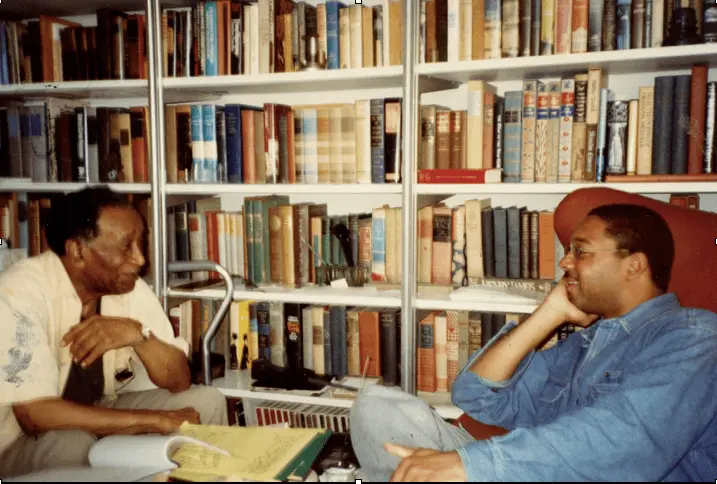
Al Murray was such a profound and great man, and you could say Al adopted me. He used to say he was my intellectual grandfather, but then he just said, “Well, just your grandfather.”
He was my mentor, friend, family member. I learned so much from him and spent so much time in his home with his deeply soulful and engaging wife, Mozelle, and she truly took care of me like I was her grandson.
Al’s body of work and thought expanded my conception of the world and the possible. Reading his books and engaging in countless conversations and arguments with him clarified my understanding of the role of the arts and my understanding of the need to always search and to know.
To be around Mr. Murray was to be around someone who had 70 years of engagement. One book may have clippings from a 1942 newspaper. His library was formidable. It was deep, and he [would] pick any book and say, “Go pull that book off or pull this off. Turn to page 73. We’re going to talk about the laws of thermonuclear dynamics today. Entropy, the tendency of things to go random, [that] they’ll go from one thing to another…”
It’s so appropriate that this award is named the Albert Murray Award for Omni-American Excellence because he believed that the American experience at its finest was mulatto, and it was a hybrid experience. There was no such thing as a pure America. And he was all about excellence in studying and about, of course, down-home swing.
Mr. Murray was about context. He always said, “Get all these big anthologies and read them and learn. Get the broadest outline and then focus on the specifics.”
The first book Mr. Murray gave me to read was Thomas Mann’s Joseph and His Brothers. Man, it’s such a huge book. So, I read it, and I asked him, “Man, why did you have me read that?” He said, “Because you have to know that the blessing is also a curse.”
The first book Mr. Murray gave me to read was Thomas Mann’s Joseph and His Brothers. Man, it’s such a huge book. So, I read it, and I asked him, “Man, why did you have me read that?” He said, “Because you have to know that the blessing is also a curse.”
The entire highlight of my time with him was [that] he’s a man of such deep knowledge and caring and belief in democratic principles and of the durability of American democracy. I wish he were alive right now so I could just have some good down-home talks with him. But I urge each of you to read his books, to read him: The Omni-Americans: Black Experience in American Culture, The Hero and the Blues, South to a Very Old Place ‒ my favorite ‒ and Stomping the Blues.
Thank you all so much. We are many. Let us also be one. Let’s be unified in our embrace of humanism, cultural excellence, and democracy. Let us not be tribal. Good night, everyone. Thank you.
After-Chorus: American Nobility, or Soul
by Aryeh Tepper
When Wynton Marsalis recalls Albert Murray telling him to read Thomas Mann’s Joseph and His Brothers and adding an interpretive key, “You have to know that the blessing is also a curse,” he tells a story signifying a line of inquiry into the modern meaning of nobility.
In Beyond Good and Evil, Nietzsche asks, “What is noble? What does the word ‘noble’ still mean to us today?” He answers that “it is the faith that is decisive here… some fundamental certainty that a noble soul has about itself.” Nobility is not connected to birth, but to a soul’s self-knowledge and self-assurance.
Nietzsche of course was no democrat, and Thomas Mann, who studied his work, first defended a non-political, aristocratic cultural stance in Reflections of a Non-Political Man (1919). But in The Coming Victory of Democracy (1938) Mann recast nobility as a democratic demand. The democratic citizen assumes responsibility for the common good, and democracy is thus, by necessity, “thought related to life and action.” In this context (and in the face of the Nazi threat) Mann wrote that “Nietzsche is a democrat in this specifically modern sense, his almost excessive and dangerous glorification of life at the expense of… abstract truth is of a philosophic democratic character, and a very artistic one, at that.” Nietzsche’s rejection of abstract truth was interpreted by Mann to mean that thought must submit “to the earth.”
Albert Murray took up Mann’s interpretation and set it in the key of the blues. In The Hero and the Blues, art is not “for art’s sake.” It is, instead, “equipment for living,” a way of handling adversity with heroic, joyful strength. Mann’s democratic aristocrat reappears as Murray’s Joseph, the Biblical archetype of the “thought-and-action hero,” the man who affirmed life even in Pharaoh’s dungeon and transformed divinely-inspired dreams into practical schemes of action. The blues hero, like Joseph, meets complexity with form and turns chaos into life-affirming style.
Mann’s democratic aristocrat reappears as Murray’s Joseph, the Biblical archetype of the “thought-and-action hero,” the man who affirmed life even in Pharaoh’s dungeon and transformed divinely-inspired dreams into practical schemes of action. The blues hero, like Joseph, meets complexity with form and turns chaos into life-affirming style.
Murray’s student and Marsalis’ friend, Stanley Crouch, then reconnected this life-affirming style to its source: the soul. In his essay on the Constitution as a blues document, “Blues to Be Constitutional,” Crouch quotes Mann’s The Coming Victory of Democracy, “Real democracy, as we understand it, can never dispense with aristocratic attributes, if the word ‘aristocratic’ is used, not in the sense of birth or any privilege, but in a spiritual sense.” Crouch immediately adds: “A jazz musician would probably say soul” (italics in the original). Likewise, in “Premature Autopsies,” Crouch’s contribution to Wynton’s The Majesty of the Blues, Crouch opens by equating nobility with soul and celebrating jazz as itself an action, “Like a knight wrapped in the glistening armor of invention, of creativity, of integrity, of grace, of sophistication, of SOUL, this sound took the field.”
So how is the blessing that Murray passed on to Marsalis also a curse?
Once the blessing is received, then evasions, falsifications and mediocrity become intolerable, and the isolation grows. Murray’s sense of American nobility is thus double-edged: a disciplined joy in form and swing joined to a steady awareness of the pressure toward ressentiment and sentimentality.
Is a noble, soulful community possible?
When nobility is understood as a unity of thought and action, it seeks forms through which insight can be shared, including music and literature. One of the jazz bandstand’s functions is to serve as a site for the ritual enactment of this noble, soulful community. No one understands this relationship between jazz and life more fully than Wynton Marsalis, the 2021 recipient of the inaugural Albert Murray Award for Omni-American Excellence, whose work as Managing and Artistic Director of Jazz at Lincoln Center has long treated jazz as “a metaphor for democracy,” with blues, swing and improvisation as disciplines of shared freedom. In extended works such as Blood on the Fields, which follows two protagonists learning to connect freedom with communal responsibility, In This House, On This Morning, which refracts the Black American church service through the blues and Bach-like chorale, and The Democracy! Suite, a Covid-era affirmation of democracy’s ensemble give-and-take, Marsalis stylizes American life on an elevated plane of human excellence. The same demand for soulfulness animates The Majesty of the Blues, where blues-idiom wisdom becomes “equipment for living” and a way of facing adversity with elegance. In all of this, Marsalis embodies Murray’s double-edged blessing: a blues-inflected, soulful nobility that rejects resentment and sentimentality and calls a community into being around disciplined, joyful music-making.
Aryeh Tepper is Editor-in-Chief of The Omni-American Review.