
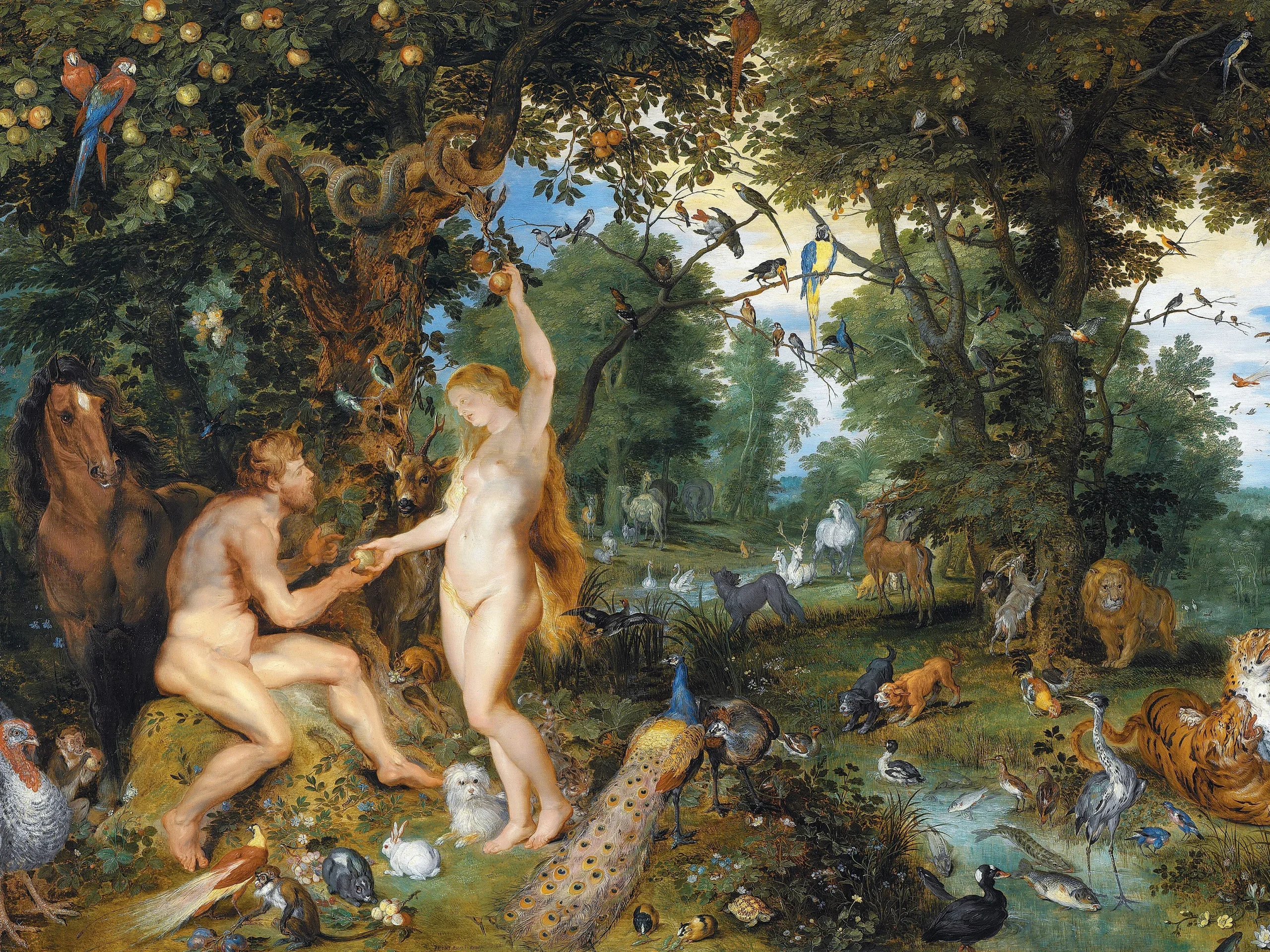
Genesis 3 may be one of the most commonly retold myths in Western civilization, yet much of its tone and style still gets lost in translation. One example that every Hebrew speaker will immediately recognize is the introduction of the snake. Upon being tempted into eating the forbidden fruit, Adam and Eve discover the shame of their nakedness (‘arum-im’). That same word is used earlier in the chapter to depict their tempter, the snake, as “the most crafty (‘arum’)” of God’s creatures. Rereading this punny tale in the original, one can’t help but chuckle. An ancient creation myth, supposedly estranged from us through time and culture, suddenly comes to life with the eternal resonance of humor. This is true of the Hebrew Bible more broadly, which, far from the doctrinal woodiness, tribalism, and savagery ascribed to it by incuriously modern critics, brims with human drama, moral dilemmas, literary brilliance, and Shakespearean wit. In both style and substance, the text justifies its canonical stature, as long as you can actually read it.
Language and attention are a culture’s barrier to entry. In the beginning of every culture, there is a language: a system of symbols that forms a parallel, imaginary world of connections and meanings. Over time—as new generations encounter, act within, and wrestle with this system—the language thickens, and the culture deepens. The investment is attention, the return is continuity.
But this connection is not a passive state. Like happiness and the good life, it is an action, a daily decision to live within a world of meaning. It’s a constant act of maintenance. For Jews, active literacy is the entry fee for discovering and rediscovering their relationship with the God of History (faith, in contrast, is close to irrelevant). But the same is true for making sense of mass culture. Just look at Harry Potter and Monty Python. Lord Voldemort’s nature is lost outside Western culture’s dialogue with death; Harry’s sacrifice seems inexplicable outside of messianic narratives. And Monty Python? Their absurdity is funny because it does violence to the language and forms it was born of; without this cultural background, it’s just gibberish.
Writer, poet, critic, and blues-philosopher, Albert Murray, teaches us to see the giants of culture as carrying and affirming the tradition while also extending, elaborating, and refining it into new, vital forms. It’s Louis Armstrong elaborating and refining a standard into a new song. It’s Caravaggio pushing light and shadow to an almost unbearable pitch. It’s Gabriel Garcia Marquez breaking in the middle of a novel to follow a sentence that refuses to end. Albert Murray would describe these artists making epoch-defining statements as heroes, plunging into the abyss to slay the dragon and reemerging, hopefully triumphant, with their innovations.
Writer, poet, critic, and blues-philosopher, Albert Murray, teaches us to see the giants of culture as carrying and affirming the tradition while also extending, elaborating, and refining it into new, vital forms.
To break (or reinvent) their own tradition, the hero must first possess knowledge of it. Then, if courage allows, the quest to conquer the tradition can begin. The hero knows perfectly well what’s lurking below, and despite it, jumps. To jump without this knowledge isn’t courage, just reckless arrogance (or plain stupidity). A pianist in a jazz ensemble does not “take a solo” before she has learned the language of harmony, rhythm, and melody, the habits of her bandmates, and the shape of the tune. Without that preparation, a leap into freedom is not courage but noise.
But learning the cultural language of a tradition is no small task. It takes a lifetime of attention. Even before human cognition was squeezed into the length of social media reels, few had the will to make that kind of investment. Nowadays, the request itself seems incomprehensible, as even college professors in the country’s most elite universities, once the custodians of our civilizational language, have given up on trying to get their students to watch a film (!) or read a book. The canon wars of the 1990s look, from here, almost innocent.
That’s why for every hero there are countless pretenders, resentful of the virtuosity they cannot achieve and of the culture that, in demanding their attention, humbles them. For many of them, the solution is kitsch.
That’s why for every hero there are countless pretenders, resentful of the virtuosity they cannot achieve and of the culture that, in demanding their attention, humbles them. For many of them, the solution is kitsch.
Kitsch, whether in music or literature or art or film, draws on the language of its craft just enough to tickle our senses with recognition, with safe familiarity, but not an inch beyond that. It offers the patina of culture for easy consumption, giving us the sensation that we have “touched” art without the effort of learning anything. It says: you need not change; this level of attention is enough. Art forces us to face the tragic and the difficult; kitsch, by contrast, offers quick pulses of engagement that ask nothing and reassure us that looking away is fine.
Kitsch often manifests in harmless forms, such as hotel‑lobby paintings and algorithmic mood‑playlists—small, sugary doses of atmosphere. Microdoses of false awe for the inattentive, perhaps, but nothing worse. But kitsch is also essential to something more insidious: what we might call “instrumental art.” Soul-less creativity in the service of something else, like marketing or political propaganda.
Albert Murray pejoratively dismissed as “social science fiction” such works of kitsch that take the form of art only as a ploy to indoctrinate the masses. These are stories written not to reveal truth, but to remold society. Such didactic effrontery isn’t just a parody of heroic art, but the inversion of it. If art deepens the human experience through enrichment and refinement of forms (language and attention!), “social science fiction” narrows it, choking it into orthodoxy.
This is anti-art. In fact, this is anti-humanity. Those who keep demanding that art exists solely to send “the right” message tell on themselves. Because underneath the obsessive desire to mold society, there’s a hatred of humanity.
The real artist wants to behold humanity in all its true contradictions; the “social science artist” wants to fix humanity. The real artist wants to refine herself; the “social science artist” wants to solve others.
The real artist wants to behold humanity in all its true contradictions; the “social science artist” wants to fix humanity. The real artist wants to refine herself; the “social science artist” wants to solve others.
The cost is not only aesthetic. A culture that abandons heroic quests through language and history in favor of safe, didactic kitsch gradually loses the capacity for tragic self‑knowledge.
Keeping up with culture makes heavy demands on the individual. It is a humbling experience. Some, in their humility, will find comfort in kitsch. But many others refuse. In being humbled, they only grow resentful. Inattentive and languageless, they lack the tools to construct meaning. From here it is a short step to the conclusion that the world must be remade from scratch. Bukowski’s judgment in “The Genius of the Crowd” still rings true: “They will consider their failure as creators only as a failure of the world.” They will be the most strident advocates of “social science art” precisely because it will stand as their rebuke of art. It will either replace heroic art or destroy it.
This latent hatred of humanity leads toward a clear end. A culture, if I can call it that, that’s fixated on fixing humanity, resentful of our fallen nature, and indifferent to the tragic human soul, will develop Millenarian tendencies. All efforts to fix the “squalor” of humanity are doomed to fail, but from the perspective of the anti-artist, this failure means that the only solution is a do-over. A purge. A flood.
For the hero of culture, there’s everything to conserve and everything to lose. For the anti-artist, there’s nothing worth saving, nothing to lose (or at least so they think). And if you pay attention to the tone taken recently by many elite institutions of cultural education and supposedly high art, there is a growing theme of despair that borders on eschatological. There’s something in it of what Stanley Crouch called “nostalgia for the mud”—noble savage kitsch. A fantasy about Eden, before the fall of man, driven by an annihilistic thrill preceding the rapture. The pleasures of anarchy with the conceit of piety and the thrill of destruction dressed up as moral urgency.
And if you pay attention to the tone taken recently by many elite institutions of cultural education and supposedly high art, there is a growing theme of despair that borders on eschatological. There’s something in it of what Stanley Crouch called “nostalgia for the mud”—noble savage kitsch.
When annihilism takes hold, art no longer enhances our humanity; it prepares our disappearance. In such a culture, would‑be artists trade the hard work of inheritance for the thrill of erasure. Given time, the small, mischievous puns of Genesis will be lost, the past thinned into a vague backdrop, and the present flattened into something merely manageable. A world that has forgotten how to read its own stories will still hunger for destruction, but it will have nothing left to break except itself.