The Omni-American Vision
In much contemporary “anti-racism” and “anti-DEI” discourse, race functions less as a problem to be overcome than as a fixed identity to be managed. Robin DiAngelo’s work is emblematic of this model: “white identity” is treated as inherently complicit in white supremacy, and efforts to reclaim older ethnic or cultural inheritances are often dismissed as “color-blind racism.” In this outlook, the task becomes learning to inhabit racial labels differently rather than questioning the labels themselves. The Omni-American vision that I delineate in this essay challenges the race-based model of “anti-racism,” arguing that it keeps racial categories central and enduring when what we need is a way to move beyond them.
Over the course of my life, I have tried on several identities for size, from liberal and conservative political ideologies to born-again Christianity to black nationalism and Afrocentric spirituality. Yet, the secular culture that had formed me ‒ especially blues and jazz ‒ kept pointing beyond those boxes. Out of that tension, I’ve come to embrace a culturally centered Omni-American identity. Rooted in a deep appreciation for the homegrown design and innovation of blues and jazz as art forms and cultural technologies, the Omni-American idea derives from the thought and writings of Albert Murray, whose first book, published in 1970, was titled The Omni-Americans: Some Alternatives to the Folklore of White Supremacy. His philosophy showed me how to honor the heroic creativity of my ethnocultural kinfolk while facing the cauldron of enslavement and Jim Crow segregation in which blues, jazz, and other cultural forms were steeped and sculpted. As an Omni-American, I affirm both my American identity and my Afro-American heritage without shame or guilt, and I extend that affirmation to my fellow Americans as well, even when we part ways politically.
Poet Elizabeth Alexander begins the final section—Coda—of her poem “Omni-Albert Murray” as such:
“Omni: having unrestricted, universal range.”
That one word, Omni, helps name what I found in the work of Ralph Ellison and Murray. For Ellison, American culture is a “composite, pluralistic culture-of-cultures,” shaped from the start by Negro American idiomatic style yet open to many sources. He draws a sharp line between race and culture, insisting that culture is not transmitted through the genes but through shared practices, idioms, and ways of making meaning. Murray extends that insight into a full philosophy and method, declaring race a “sterile category” and treating both white supremacy and the folklore of black pathology as myths to be dismantled. He reframes the Negro idiom as the blues idiom: an attitude of affirmation in the face of difficulty, improvisation in the face of challenge, and elegance in the face of life often being a “low-down dirty shame.”
Omni-Americans are Americans freed from the chains of thought and behavior that limit the vision and aspiration derived from our, as Ellison put it, “sacred” founding documents: the Declaration of Independence, the Constitution, and the Bill of Rights. Omni-Americans are universal Americans, striving to embody the best principles and values in our creeds and motto, E Pluribus Unum: “Out of many, one.” My Omni-American identity has led me to disavow the very concept of race and the practice of racialization, the process by which race, whether biological or as a social construct, becomes embedded as an accepted identity. Although American society ascribes a racial identity to me, I insist on unsubscribing from that platform of doom.
Omni-Americans are universal Americans, striving to embody the best principles and values in our creeds and motto, E Pluribus Unum: “Out of many, one.” My Omni-American identity has led me to disavow the very concept of race and the practice of racialization, the process by which race, whether biological or as a social construct, becomes embedded as an accepted identity. Although American society ascribes a racial identity to me, I insist on unsubscribing from that platform of doom.
From this vantage point, deracialization is not colorblindness or evasion. It is a clear-sighted willingness to see culture where others see only race, to recognize idiom where others impose essence, and to insist that American life is richer and more entangled than our racial scripts allow. It also means challenging the assumption, found in DiAngelo and much of contemporary “anti-racism,” that our primary task is to manage fixed racial identities rather than to move beyond them. In what follows, I turn to Ellison and then to Murray to show how their Omni-American vision offers a fuller, more generative way to confront racism without remaining captive to the very idea of race.
The Ellison-Murray Continuum: Ellison’s Riff
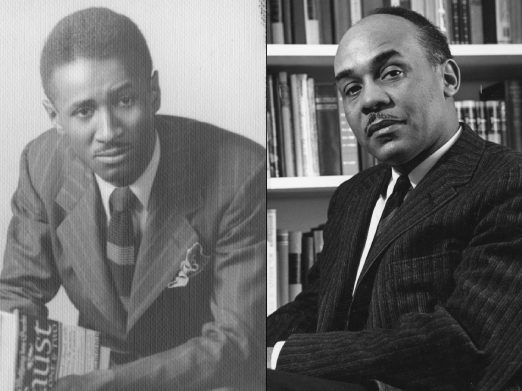
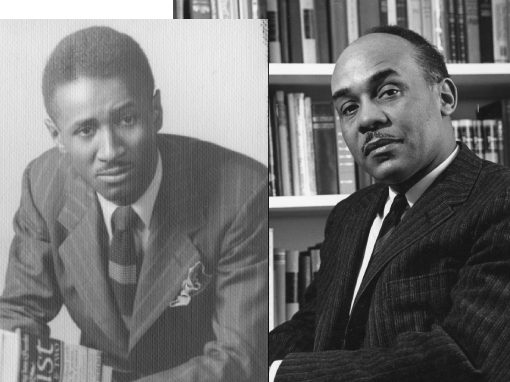
The work of Ellison and Murray is a distinct school of American thought with Afro-American origins. Henry Louis Gates Jr. observed in his 1996 essay, “King of Cats,” that the two men were “part of a single project” animated by a profound philosophical aesthetics of blues and jazz. I call that project “the Ellison-Murray continuum,” and I argue that it offers the conceptual and cultural tools that we need to move from a racial framework to an Omni-American one.
The argument begins with a basic but consequential distinction: culture is not race. In a 1958 letter to Murray, Ellison recounted an exchange at the Newport Jazz Festival in which a composer-critic insisted that jazz was not connected to the lives of any racial group. Ellison’s reply cut to the heart of the matter: “I don’t fight the race problem in matters of culture, but anyone should know the source of their tradition before they start shooting off their mouth about where jazz comes from.” Here, he separates questions of race from questions of culture while insisting that cultural forms have real, traceable sources.
Ellison was equally clear in a 1958 interview, “I know of no valid demonstration that culture is transmitted through the genes… Nor should the existence of a specifically ‘Negro’ idiom in any way be confused with the vague, racist terms ‘white culture’ or ‘black culture’; rather, it is a matter of diversity within unity.” The phrase “diversity within unity” is a riff on E Pluribus Unum, and Ellison expanded on it throughout his career. In a 1970 Time magazine piece, he wrote that without Negro American style, American humor, storytelling, and sports would lack “the sudden turns, shocks and swift changes of pace (all jazz-shaped) that serve to remind us that the world is ever unexplored.” Taken together, these statements offer an alternative to the idea of fixed racial cultures: Afro-American style is both particular and constitutive of the larger American whole.
In a 1979 address at Brown University, Ellison made the point through a concrete historical example. He traced the New England educational tradition that shaped both him and Dr. Inman Page, one of the first Afro-American graduates of Brown, to describe the long relationship between so-called “black” and “white” Americans within that shared world. He argued that “between the two racial groups, there has always been a constant exchange of cultural and stylistic elements. Whether in the arts, education, athletics, or in certain conceptions and misconceptions of democratic justice, interchange, appropriation, and integration (not segregation) have been the constants of our developing nation.” American culture, Ellison insisted, is “a composite, pluralistic culture-of-cultures,” and all of its diverse elements have been inspired by the nation’s founding ideals.
American culture, Ellison insisted, is “a composite, pluralistic culture-of-cultures,” and all of its diverse elements have been inspired by the nation’s founding ideals.
What, then, is culture? In a 1963 lecture, Ellison offered this definition, “I’m talking about how people deal with their environment, about what they make of what is abiding in it, about what helps them to find their way, and about that which helps them to be at home in the world. . . . If you can abstract their manners, their codes, their customs and attitudes into forms of expression, if you can convert them into forms of art, if you can stylize them and give them many and subtle range of reference, then you are dealing with a culture.” Culture, in this sense, is a technology of survival and transcendence as well as a living, transmittable practice. This definition allows us to see what is often called “race” as a cluster of cultural habits, idioms, and responses to circumstance rather than as a natural essence.
In a 1977 interview with Ishmael Reed, Quincy Troupe, and Steve Cannon, Ellison makes this distinction yet again, “… the pervasive operation of the principle of race (or racism) in American society leads many non-Blacks to confuse culture with race [and] prevents them from recognizing to what extent American culture is Afro-American. This can be denied, but it can’t be undone because the culture has had our input since before nationhood. . . . While others worry about racial superiority, let us be concerned with the quality of culture.” Here Ellison names the very confusion that marks much of today’s “anti-racist” and “anti-DEI” discourse: by conflating race and culture, we miss how deeply Afro-American idioms already shape the common life we share.
Nearly fifty years later, that confusion of race and culture isn’t limited to non-Black folks. It’s everywhere. Which is precisely why Ellison’s clarity matters more than ever, and why his distinction between race and culture prepares the ground for Murray’s method of deracialization.
The Ellison-Murray Continuum: Murray’s Riff
Ellison established the philosophical ground; Murray elaborated on it and gave the argument a structural method.
In the opening chapter of The Omni-Americans, he declared race a “sterile category” that is “hardly useful as an index to human motives as is culture.” In a 1994 interview with novelist Louis Edwards, he explained that the book’s animating idea was that America itself is fundamentally a “mulatto culture” — interwoven, composite, irreducibly plural, “You can’t be an American unless you are part us,” he said, “just as you can’t be an American unless you’re part them.” Omni-American, then, is not an exclusively Black American category but a universal American one. “We’re looking for universality,” he said. “We’re looking for the common ground of man.”
From there, Murray made the case against race directly, “You can’t define race. It doesn’t meet our intellectual standard with scientific observation and definition. It won’t meet it. Race is an ideological concept. It has to do with manipulating people, and with power, and with controlling people. It has no basis in reality.” What has a basis in reality, he argued, is culture, specifically what he called idiomatic patterns, the ways that shared environments, histories, and practices shape how people express their common human impulses. “If you look at racial characteristics… you cannot get a scientific correlation between how the guy looks and how he behaves. If you find a large number of people who look like each other and behave like each other, it’s because of the culture.”
Murray’s method for moving from that diagnosis toward liberation followed three essential steps: deconstruction, reframing, and reconstruction. First, he deconstructed white supremacy as “sociopolitical and psychopolitical folklore,” a social and psychological folk belief rooted in tribalism and designed to wield power. He applied the same skepticism to its corollary: the narratives of Black “cultural deprivation,” “self-hatred,” and a so‑called “culture of poverty,” which he dismissed as “the fakelore of black pathology.” In his view, both sets of stories were ideological constructs rather than descriptions of reality.
Second, he reframed the terms of identity. The “Negro idiom” — which Ellison called a “style and total way of life” — Murray expanded from an ethnic particularity into a universal aesthetic philosophy: the blues idiom. He described it, in a 1996 interview, as “an attitude of affirmation in the face of difficulty, of improvisation in the face of challenge. It means you acknowledge that life is a low-down dirty shame yet confront that fact with perseverance, with humor, and above all, with elegance.” In Murray’s hands, the blues idiom became a metaphor for how human beings might best navigate an uncertain, adversarial world.
Third, he reconstructed American identity itself. Disavowing what his late friend Stanley Crouch called “the decoy of race,” Murray recast the American as Omni-American: a hybrid, rooted yet cosmopolitan, a pluralistic synthesis anchored not in racial mythology but in the nation’s founding ideals as articulated in the Constitution, the Declaration of Independence, and the Bill of Rights. To that canon of sacred documents, I would add the Reconstruction Amendments and Lincoln’s Gettysburg and Second Inaugural addresses.
Deconstruct the folklore. Reframe as idiomatic. Reconstruct the identity. That was Murray’s method, and it remains among the most intellectually rigorous and culturally generative responses to the problem of racism that American thought has produced.
Deconstruct the folklore. Reframe as idiomatic. Reconstruct the identity. That was Murray’s method, and it remains among the most intellectually rigorous and culturally generative responses to the problem of racism that American thought has produced.
An Omni-American Future
Popular and academic discourse too often constricts our vision, reflexively reducing the complexity of American life to the single category of race. We need a more adequate vocabulary for confronting and overcoming racism, a frame that names the disease precisely without spreading the contagion. The Omni-American vocabulary of Ralph Ellison and Albert Murray offers such a starting point, built not from abstraction but from American idiomatic particulars such as the blues, improvisation, and swing.
Omni-Americans comprise the many who share a common American identity without erasing their different histories and idioms. That oneness, or as philosopher Danielle Allen puts it, that wholeness, is not a fait accompli but an aspiration, a democratic horizon we are always in the process of reaching toward. As Ellison once put it, that’s the real secret of the game: not mastering life per se, but the commitment to make life swing.
Deracialization is not colorblindness. It is a clear-sighted willingness to see culture where others see only race, to recognize idiom where others impose essence, and to insist on the composite, pluralistic, beautifully knotted reality of what America actually is and has always been. That is the work. In committing ourselves to carrying that work forward, we can help free ourselves from a worldview built on the folklore of race and step more fully into the generative, improvisational promise of American culture.